
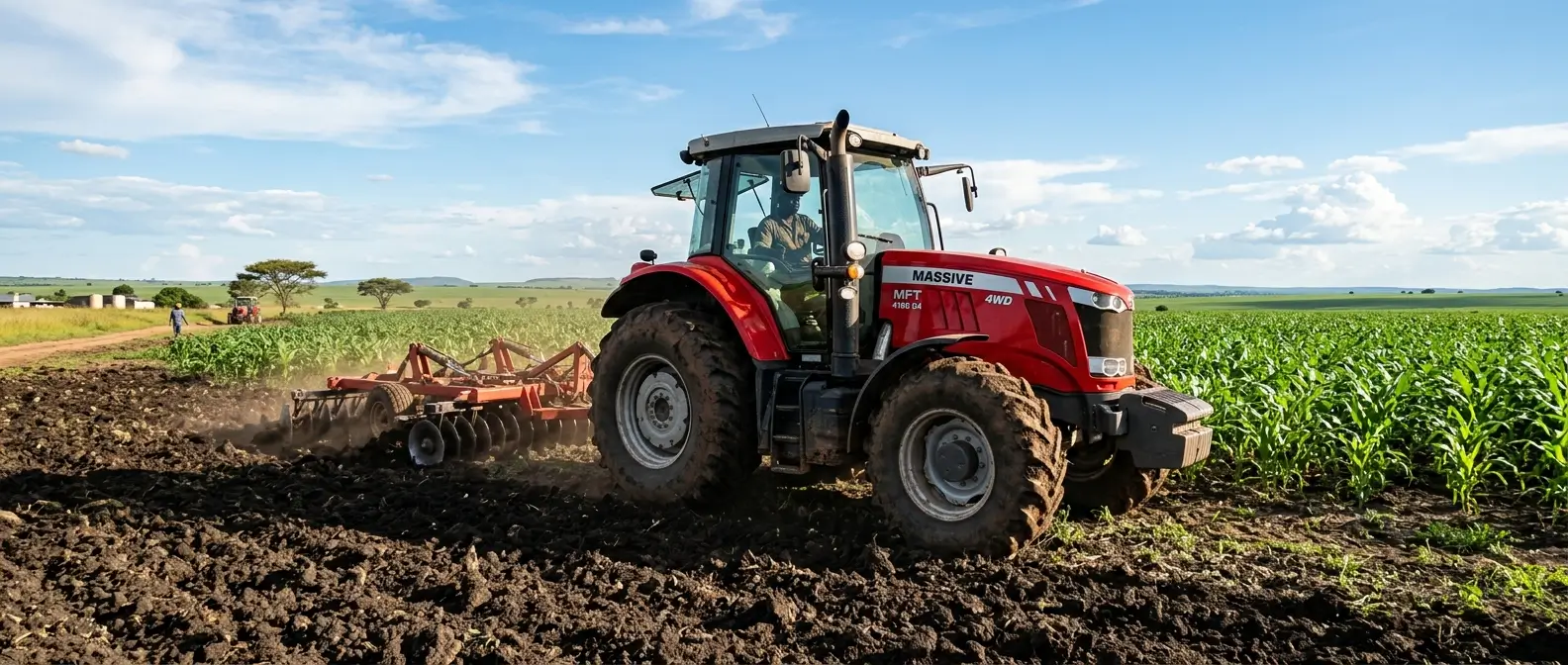
Mechanisation matters for Malawi’s 2-hectare farms because it reduces labour time, increases yields, and allows smallholders to plant and harvest within optimal weather windows. For farmers working small plots with limited family labour, even modest mechanisation—such as two-wheel tractors or shared equipment—can transform productivity and household income.
What challenges do Malawi’s smallholder farmers face without mechanisation?
Without mechanisation, smallholder farmers in Malawi rely almost entirely on manual labour and hand tools, which slows every stage of production. Land preparation using a hoe can take weeks, often causing farmers to miss the narrow planting window dictated by Malawi’s rainy season. This delay directly reduces yields, as crops planted late typically mature poorly or fail altogether.
Key challenges include:
- Labour-intensive land preparation that limits the area a household can cultivate
- Missed planting windows due to slow manual tilling
- Physical strain on farmers, particularly women and children who often shoulder much of the work
- Limited capacity to expand beyond subsistence farming
How does mechanisation improve yields on small farms?
Mechanisation improves yields by enabling timely planting, more precise seed spacing, and better soil preparation. Tractors and mechanised implements till soil more evenly than hand tools, improving water retention and root development. According to agricultural extension data commonly cited across sub-Saharan Africa, timely planting alone can increase maize yields by 20–30%, a significant gain for a 2-hectare farm.
Benefits of mechanised land preparation include:
- Faster turnaround between harvest and replanting
- Deeper, more consistent tillage for stronger root systems
- Reduced soil compaction compared to repeated hand-hoeing
- More land cultivated within the same season
Is mechanisation only suitable for large farms, or does it work for 2-hectare plots too?
Mechanisation is not exclusive to large commercial farms; it is increasingly practical for Malawi’s smallholders through right-sized equipment and shared-access models. Two-wheel tractors and compact implements are designed specifically for plots under 5 hectares, making them well-suited to Malawi’s typical farm size.
- Large farms benefit from full-size tractors for efficiency at scale
- 2-hectare farms benefit most from compact or two-wheel tractors, which balance power with manoeuvrability in smaller fields
- Shared ownership or rental schemes, such as those offered through Tractors Malawi, allow smallholders to access machinery without the full cost of ownership
What should farmers consider before investing in mechanisation?
Farmers should weigh upfront costs, maintenance access, and training needs before investing in mechanisation. Reliable local servicing is essential, since breakdowns during planting season can be costly. Exploring financing or rental options through a trusted local supplier such as Tractors Malawi can lower the barrier to entry significantly.
Frequently Asked Questions
How much does a two-wheel tractor cost in Malawi?
Costs vary by model and supplier, but financing and rental options are often available through local dealers like Tractors Malawi, making equipment more accessible to smallholders.
Can mechanisation help with both planting and harvesting?
Yes, mechanised implements support multiple stages, including ploughing, planting, and in some cases harvesting, depending on the equipment used.
Do I need special training to operate farm machinery?
Basic operator training is recommended and is often provided by equipment suppliers to ensure safe and efficient use.
Tags: Massey Ferguson Tractors, Tractors for Sale, Tractors in Malawi